
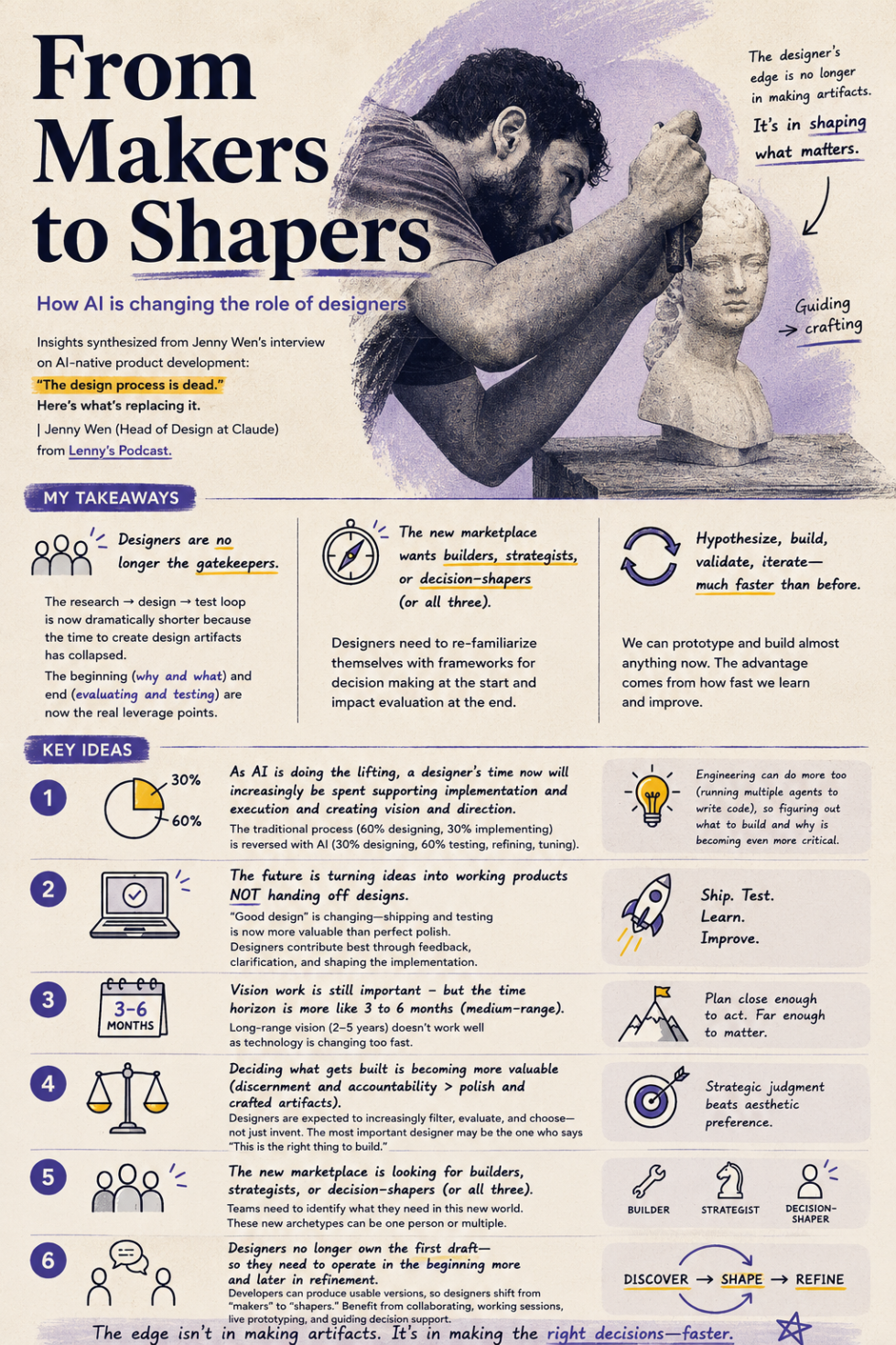
Insights synthesized from Jenny Wen’s interview on AI-native product development
My Takeaways
After watching Jenny Wen’s interview, a few things stand out to me: designers are no longer the gatekeepers (and in the mind of others, the “bottleneck”) in terms of the design artifacts. Does that make them useless? Absolutely not. But what this means is that in the research, design, test loop (or learn, build, measure or whatever you want to call it) – is now shortened due to the time it takes to make the design artifact. The beginning (why and what we are building) and end (evaluating and testing) becomes important in a world where (hypothetically) we can prototype and build anything.
The new marketplace is looking for builders, strategists, or decision-shapers (or all three). I think this means designers need to spend a lot more time building things and re-familiarizing themselves with frameworks that help with decision marking (typically, at the beginning of projects for “why and what are we thinking of building” and at the end “will/did this achieve our outcome?).
Ultimately I think this means designers will need to generate hypotheses, building prototypes, get feedback (validate) and iterate – much faster than before.
Key Ideas
- As AI is doing the lifting, a designer’s time now will increasing be spent supporting implementation and execution and creating vision and direction The traditional design process (where designs took 60% of the time to make, and 30% of time was spent to implement and tune) is dead. The reverse is happening with AI tools (with 30% of time required to make the designs, and now 60% of the time to help test, refine, and tune).
That being said, engineering can do more too (running multiple agents to write code) so figuring out what to build and why is becoming important as well.
- The future is turning ideas into working products NOT handing off designs The definition of “good design” is changing – as shipping and testing is more emphasized than getting it perfect. Designers can contribute best through feedback, clarification, and shaping the implementation
- Vision work is still important – but the time horizon is more like 3 to 6 months (medium-range) Long-range vision ideas (like 2 year or 5 year vision) doesn’t work well as the technology is rapidly changing
- Deciding what gets built is becoming more valuable (discernment and accountability > polish and crafted artifacts) Designers are being expected to increasingly filter, evaluate, and choose – not just invent. The most important designer may be the one who says “This is the right thing to build, a strategically strong experience” rather than “this is the best aesthetic option or this is technically impressive”
- The new marketplace is looking for builders, strategists, or decision-shapers (or all three) Teams need to identify what they need in this new world choosing from new archetypes: builder, strategist, or decision-shaper – which could be one person or multiple.
- Designers no longer own the first draft – so need to operate in the beginning more and later in refinement. Since developers can produce usable versions, designers are no longer the gatekeepers. Instead, designers they can shift from “makers” to “shapers” – they can benefit from being collaborators, doing working sessions, live prototyping, guiding decision support.
Mindmap
https://mapify.so/share-link/yKrM8BNOd4